
Cashless vs Reimbursement Health Insurance: Claims, Benefits, Rules & Tax
A medical emergency can create significant financial pressure, especially when hospital bills run into several lakhs. While health insurance helps cover eligible medical expenses, the method used to settle a claim can significantly affect how much money a patient must arrange immediately.
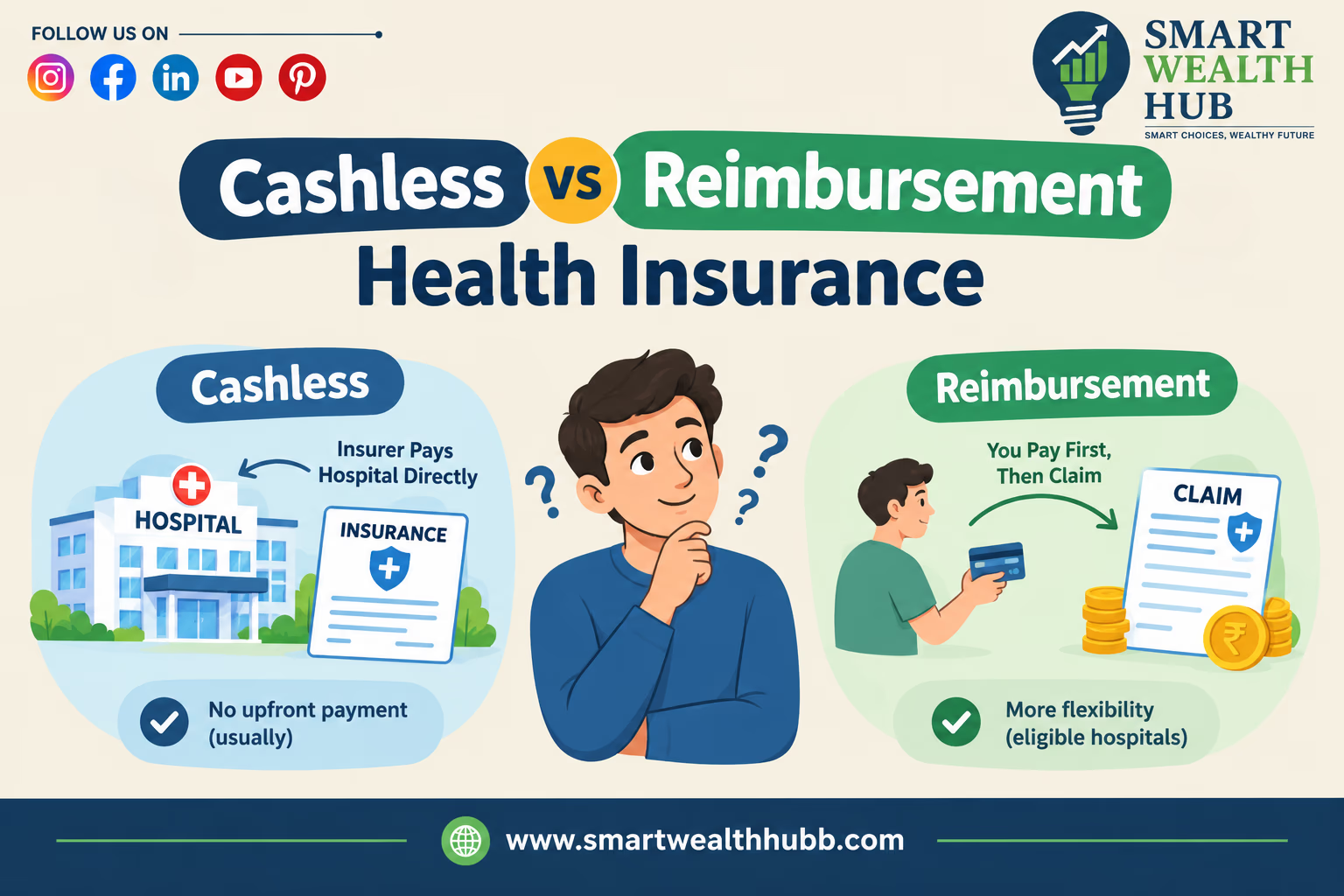
In India, health insurance claims are commonly settled through two methods: cashless settlement and reimbursement.
Under cashless treatment, the insurer directly settles approved hospital expenses. Under reimbursement, the policyholder initially pays the hospital and subsequently claims eligible expenses.
Understanding how these methods work can help individuals manage hospitalisation expenses, maintain emergency savings, and avoid unnecessary claim delays.
1. What Is Cashless Health Insurance?
Cashless health insurance is a claim settlement facility in which an insurer pays approved medical expenses directly to the hospital.
This facility is generally available at network hospitals and may also be offered at certain non-network hospitals through specific cashless arrangements.
However, cashless treatment does not mean every medical expense is covered.
Policyholders may still need to pay deductibles, co-payments, non-medical charges, and expenses exceeding policy limits.
How Does a Cashless Health Insurance Claim Work?
The process generally involves five steps:
- Hospital selection: Choose a hospital offering cashless treatment under the policy.
- Pre-authorisation: The hospital sends medical and policy details to the insurer.
- Claim assessment: The insurer evaluates eligibility, coverage, and estimated treatment expenses.
- Treatment: The patient receives treatment after the applicable approval process.
- Final settlement: The insurer pays approved expenses directly to the hospital, while the patient pays non-covered amounts.
Emergency treatment should not be delayed while awaiting insurance authorisation.
Example: Cashless Hospitalisation of ₹3 Lakh
Suppose a patient undergoes surgery costing ₹3,00,000.
| Particulars | Amount |
|---|---|
| Total hospital bill | ₹3,00,000 |
| Approved insurance claim | ₹2,75,000 |
| Excluded expenses | ₹15,000 |
| Deductible | ₹10,000 |
| Total personal expense | ₹25,000 |
Calculation:
Personal Expense = Total Hospital Bill − Insurer Payment
₹3,00,000 − ₹2,75,000 = ₹25,000
The policyholder pays ₹25,000 instead of arranging the entire hospital bill.
This is particularly useful when medical emergencies occur unexpectedly.
Related reading: How to Choose the Right Health Insurance in India — Explore coverage, exclusions, deductibles, waiting periods, and hospital networks.
2. What Is Reimbursement Health Insurance?
Reimbursement is a claim settlement method in which the policyholder initially pays hospital expenses and later submits a claim for eligible costs.
After reviewing the submitted documents, the insurer transfers the approved reimbursement amount to the policyholder.
This method is useful when cashless treatment is unavailable or when treatment is received at an eligible hospital outside the cashless network.
Reimbursement Claim Process
The process generally includes:
- Receive medical treatment at an eligible hospital.
- Pay hospital expenses.
- Collect medical reports, prescriptions, bills, and receipts.
- Submit the claim form and supporting documents.
- Wait for claim assessment.
- Receive the approved reimbursement.
Example: Reimbursement Claim of ₹4 Lakh
Consider the following hospitalisation expenses.
| Particulars | Amount |
|---|---|
| Total hospital bill | ₹4,00,000 |
| Eligible expenses | ₹3,80,000 |
| Deductible | ₹10,000 |
| Approved reimbursement | ₹3,70,000 |
| Final personal expense | ₹30,000 |
Calculation:
Reimbursement = Eligible Expenses − Deductible
₹3,80,000 − ₹10,000 = ₹3,70,000
The patient initially pays ₹4 lakh and subsequently receives ₹3.70 lakh.
Although the final personal expense is ₹30,000, the patient must temporarily arrange the entire hospital bill.
3. Cashless vs Reimbursement Health Insurance: Key Differences
| Feature | Cashless Insurance Claim | Reimbursement Insurance Claim |
|---|---|---|
| Initial payment | Insurer settles approved expenses | Patient pays initially |
| Hospital eligibility | Participating hospitals or approved arrangements | Eligible hospitals under policy terms |
| Pre-authorisation | Generally required | Generally not required |
| Documentation | Mainly coordinated by hospital | Submitted by policyholder |
| Claim payment | Directly to hospital | Directly to policyholder |
| Upfront financial burden | Generally lower | Generally higher |
| Hospital flexibility | Depends on cashless arrangements | Usually broader |
| Processing | Authorisation during hospitalisation | Assessment after document submission |
| Out-of-pocket expenses | May apply | May apply |
| Coverage | Based on policy terms | Based on policy terms |
Important: Cashless and reimbursement claims do not automatically provide different coverage amounts. The payable claim depends on policy conditions, not merely the settlement method.
4. Real Financial Comparison: Which Method Saves More Money?
Consider two policyholders undergoing identical procedures.
Both have health insurance coverage of ₹5 lakh.
Their hospital bills are ₹4 lakh each, with ₹3.70 lakh approved by their respective insurers.
| Particulars | Cashless | Reimbursement |
|---|---|---|
| Hospital bill | ₹4,00,000 | ₹4,00,000 |
| Approved claim | ₹3,70,000 | ₹3,70,000 |
| Initial payment | ₹30,000 | ₹4,00,000 |
| Later reimbursement | ₹0 | ₹3,70,000 |
| Final personal expense | ₹30,000 | ₹30,000 |
Both policyholders ultimately spend ₹30,000.
However, the reimbursement claimant must temporarily arrange an additional ₹3.70 lakh.
Opportunity Cost Calculation
Assume the reimbursement amount remains unavailable for 20 days.
At an illustrative annual interest rate of 6%:
Opportunity Cost = Amount × Annual Rate × Days ÷ 365
₹3,70,000 × 6% × 20 ÷ 365
= Approximately ₹1,216
This represents a hypothetical opportunity cost, not an insurance fee.
It demonstrates why cash-flow management matters during hospitalisation.
Interactive Calculation: Estimate Your Claim Expenses
You can estimate your potential personal contribution using:
Out-of-Pocket Expense = Total Hospital Bill − Approved Insurer Payment
For example:
- Hospital bill: ₹5,00,000
- Approved insurer payment: ₹4,25,000
- Personal expense: ₹75,000
For broader coverage planning, explore the Health Insurance Coverage Calculator and Planning Resources.
5. Cashless or Reimbursement: Which Should You Choose?
Use this simple decision flowchart before hospitalisation.
Health Insurance Claim Decision Flowchart
START : Do you have an active health insurance policy?
⬇️
Is the proposed treatment covered under your policy?
-
No: Review exclusions and available alternatives.
-
Yes: Continue.
⬇️
Does the hospital offer cashless treatment under your policy?
-
Yes: Request cashless pre-authorisation.
-
No: Check reimbursement eligibility.
⬇️
Has cashless authorisation been approved?
-
Yes: Proceed through the cashless settlement process.
-
No: Ask for the reason and check reimbursement eligibility.
⬇️
Can you arrange the initial hospital payment?
-
Yes: Reimbursement may be an option.
-
No: Discuss payment arrangements, alternative eligible hospitals, or available financial support.
Final decision: Select the available claim method based on hospital eligibility, medical requirements, policy conditions, and immediate financial capacity.
A rejected cashless request does not necessarily mean the underlying treatment is excluded. However, reimbursement is not guaranteed.
6. IRDAI Health Insurance Claim Settlement Rules in 2026
The Insurance Regulatory and Development Authority of India (IRDAI) regulates health insurance practices in India.
Its 2024 health insurance regulatory framework established important claim-processing service standards.
Verified IRDAI Claim Timelines
| Claim-Related Service | Regulatory Timeline |
|---|---|
| Cashless pre-authorisation decision | Within 1 hour |
| Final cashless discharge authorisation | Within 3 hours |
| Settlement of claims other than cashless | 15 days |
These timelines are confirmed in IRDAI's official health insurance guidance.
Official reference: IRDAI Health Insurance Department.
The one-hour timeline starts when the insurer receives the cashless authorisation request.
Similarly, the three-hour discharge timeline starts when the insurer receives the hospital's final discharge authorisation request.
The 15-day reimbursement standard is subject to the applicable regulatory framework and receipt of necessary claim information.
These timelines are service standards, not guarantees that every claim will be approved.
What Happens if a Claim Is Rejected?
Policyholders should request written reasons identifying the relevant policy conditions.
If the explanation is unsatisfactory, they can escalate the complaint through the insurer's grievance redressal mechanism.
Further escalation may be available through IRDAI's grievance system or the Insurance Ombudsman, subject to eligibility.
Official resource: IRDAI Health Insurance FAQs.
7. Health Insurance Tax Benefits in India: 2026 Rules
Eligible health insurance premiums can provide income-tax deductions under the old tax regime.
For earlier tax years, the relevant provision was Section 80D of the Income-tax Act, 1961.
The Income-tax Act, 2025 applies from 1 April 2026, with the corresponding health insurance premium deduction provided under Section 126.
Health Insurance Deduction Limits
| Eligible Category | Maximum Deduction |
|---|---|
| Self, spouse and dependent children | ₹25,000 |
| Eligible family coverage involving a senior citizen | ₹50,000 |
| Parents below 60 | Additional ₹25,000 |
| Senior citizen parents | Additional ₹50,000 |
| Maximum combined deduction in applicable cases | ₹1,00,000 |
Preventive health check-ups may qualify within the relevant limits, subject to an aggregate ceiling of ₹5,000.
The deduction is generally unavailable under the default new tax regime.
Example: Tax Savings on Health Insurance Premiums
Suppose an individual pays:
Family health insurance premium = ₹24,000
Senior citizen parents' premium = ₹48,000
Total Eligible Deduction:
₹24,000 + ₹48,000 = ₹72,000
Assuming the taxpayer is eligible for the old regime and the entire deduction reduces income taxed at 30%:
Tax Savings = ₹72,000 × 30% = ₹21,600
Including 4% health and education cess:
₹21,600 × 1.04 = ₹22,464
Actual savings depend on taxable income, marginal tax rates, and eligibility.
Important: The claim settlement method does not determine premium deduction eligibility. Qualifying premiums may receive the same tax treatment whether subsequent medical claims are cashless or reimbursed.
8. Why an Emergency Fund Is Still Important
Health insurance does not eliminate every medical expense.
Policyholders may need money for:
- Deductibles and co-payments.
- Excluded medical expenses.
- Expenses exceeding the sum insured.
- Treatment unavailable through cashless arrangements.
- Temporary reimbursement funding.
Emergency Fund Calculation
Suppose a household has essential monthly expenses of ₹45,000.
A six-month emergency reserve would be:
₹45,000 × 6 = ₹2,70,000
This reserve can support household expenses during emergencies.
However, reimbursement claims involving larger hospital bills may require additional liquidity.
Emergency savings and health insurance therefore serve complementary purposes.
Related reading: Retirement Planning and Emergency Savings.
9. Documents Required for Health Insurance Claims
Maintaining complete medical records can reduce avoidable claim-processing delays.
Cashless Claim Documents
- Health insurance policy details.
- Government-issued identification.
- Hospital admission records.
- Pre-authorisation request.
- Medical reports and prescriptions.
- Final hospital bill and discharge summary.
Reimbursement Claim Documents
- Completed claim form.
- Itemised hospital bills.
- Payment receipts.
- Discharge summary.
- Diagnostic reports.
- Prescriptions and pharmacy invoices.
- Bank details for reimbursement.
- Additional documents reasonably required under the policy.
Document requirements may vary by insurer and treatment.
Downloadable Health Insurance Claim Checklist
Use this checklist before admission, during treatment, and when submitting a reimbursement request.
It covers policy verification, hospital eligibility, essential documents, settlement follow-up, and grievance escalation.
10. Common Reasons Health Insurance Claims Are Reduced or Rejected
Health insurance claims may be reduced or rejected because of:
Waiting periods: Certain illnesses or pre-existing conditions may remain subject to waiting periods.
Policy exclusions: Some treatments or expenses may not be covered.
Room-rent restrictions: Choosing accommodation above the permitted limit may trigger additional deductions.
Co-payment clauses: Policyholders may be required to pay a specified percentage of eligible expenses.
Insufficient documentation: Missing or inconsistent records can delay assessment.
Coverage limits: Claims exceeding the available sum insured or applicable sub-limits may not be fully payable.
Before treatment, review the policy's Customer Information Sheet, coverage schedule, exclusions, and claim requirements.
11. Final Verdict: Cashless vs Reimbursement
Cashless health insurance is generally more convenient because it reduces the amount a policyholder must arrange immediately.
Reimbursement provides an alternative when cashless treatment is unavailable, but it requires greater short-term liquidity.
Neither method automatically increases the sum insured or removes policy exclusions.
The appropriate choice depends on hospital eligibility, treatment requirements, claim conditions, and the patient's financial situation.
The most effective approach is to maintain adequate health insurance coverage, understand both settlement methods, and preserve accessible emergency savings.
📋 Want a FREE Health Insurance Claim Checklist?
💬 Comment “CHECKLIST” below and get a handy guide to make your cashless or reimbursement claim process easier!
Frequently Asked Questions
What is the main difference between cashless and reimbursement health insurance?
In cashless settlement, the insurer directly pays approved medical expenses to the hospital. In reimbursement, the policyholder initially pays the bill and later receives the approved claim amount.
Can I claim reimbursement if cashless treatment is rejected?
Yes, reimbursement may still be possible if the treatment is covered and the policy permits reimbursement. However, rejection because of a policy exclusion may affect both settlement methods.
How long does reimbursement take in India?
IRDAI's 2024 health insurance guidance specifies a 15-day turnaround standard for claims other than cashless claims. Actual processing depends on applicable requirements and the availability of necessary information.
Can cashless health insurance be used at a non-network hospital?
It may be available through specific insurer arrangements. Policyholders should confirm availability directly with the insurer and hospital before relying on cashless settlement.
Is the tax deduction different for cashless and reimbursement claims?
No. Eligible health insurance premium deductions depend on tax law, payment conditions, and the taxpayer's tax regime rather than the subsequent claim settlement method.
These articles are for awareness. For advice suited to your goals, talk to our team.
Book a free consultationDisclaimer: Views in this article are for educational purposes and do not constitute personalised financial, tax, or investment advice. Markets involve risk — read all related documents carefully.



Comments0
No comments yet. Be the first to share a thought.