
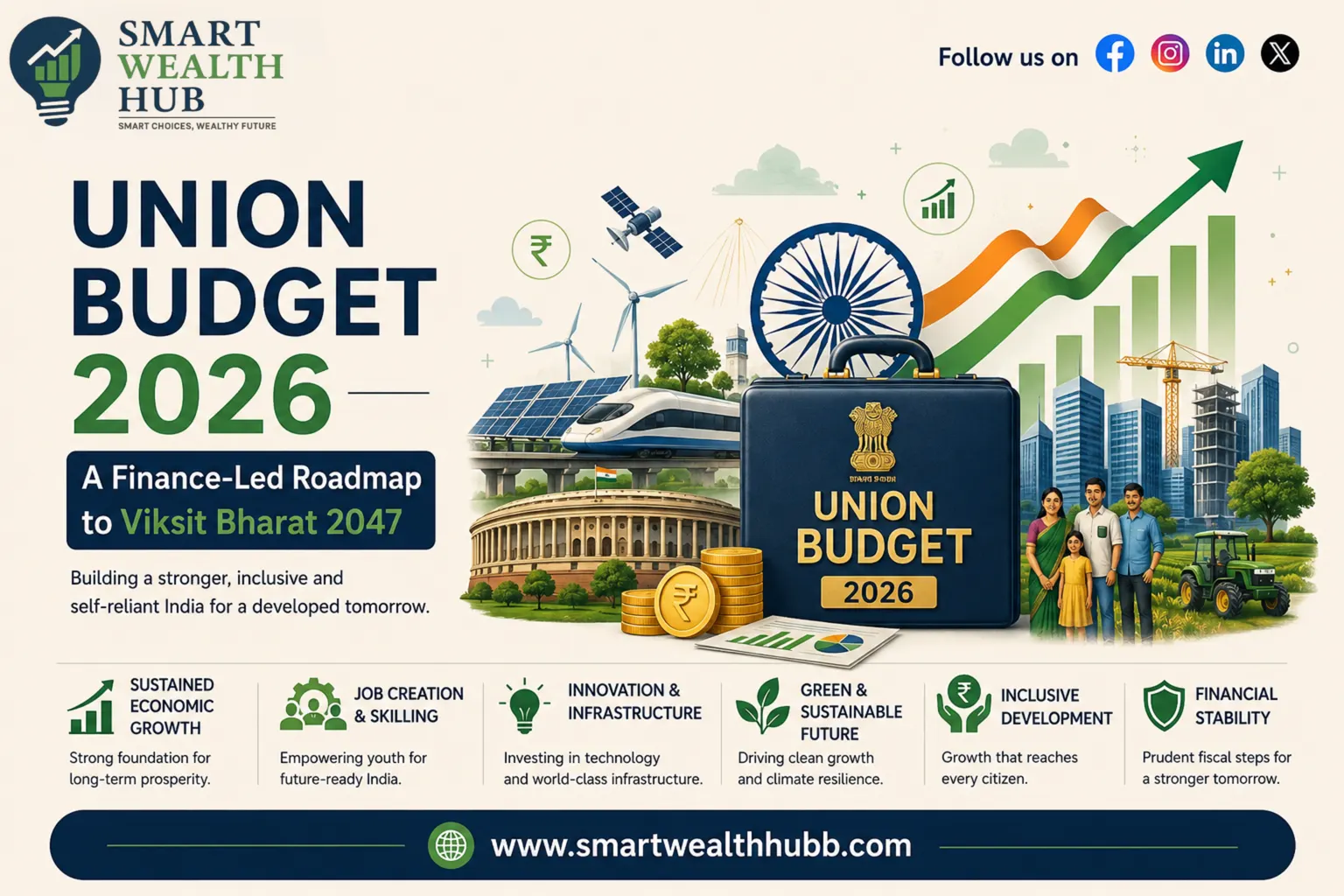
Union Budget 2026: Financial Roadmap to Viksit Bharat 2047
📊 Executive Summary
“Growth with Discipline — A Structural Budget for Competitive India”
On 1 February 2026, India’s Finance Minister presented the Union Budget for FY 2026–27, marking her ninth consecutive Budget. This fiscal blueprint anchors investment-led growth, fiscal consolidation, structural competitiveness and enabling tax reforms.
Core Strategic Priorities:
- Fiscal Consolidation: Targeted reduction in fiscal deficit, reflecting disciplined public finances.
- Capital Expenditure: Elevated public capex allocation, reinforcing infrastructure as a core growth driver.
- Tax & Compliance Reforms: Introduction of the new Income Tax Act (effective April 1 2026), with simplified compliance frameworks and procedural relief for taxpayers.
- Growth Enhancement: Focus on manufacturing competitiveness, export support, technology-driven sectors and MSME empowerment.
- Inclusive Development: Social sector enablement, women-led enterprise initiatives, rural technology platforms and financing innovation pathways.
- State-Centre Fiscal Relations: Retention of state tax devolution share, balancing autonomy expectations with central strategy.
Overall, the budget emphasises structural reforms over populism, aligning resources toward long-term resilience, productivity enhancement, and competitiveness in the global economic landscape.
📌 Sector-Wise Analysis
1. Infrastructure & Connectivity
Tagline: “Building the Foundations of Future Growth”
- Capital expenditure has been raised significantly to maintain momentum on large-scale infrastructure projects.
- Emphasis on multi-modal connectivity, urban and regional transport infrastructure, and logistics networks.
- Focus on developing Tier-II/Tier-III city infrastructure to unlock regional economic potential.
- Policy support for capital goods and construction value chains enhances investment multipliers.
Implication: Strengthens physical capital formation and reduces bottlenecks in supply
chains, enhancing productivity across sectors.
2. Manufacturing & Strategic Industries:
Tagline: “From Make in India to Lead in India”
- Expansion of strategic missions such as semiconductor ecosystem (Mission 2.0) with substantial outlays.
- Introduction of Biopharma SHAKTI to develop domestic biological and biosimilar capabilities.
- Dedicated schemes like rare earth corridors and chemical parks to deepen industrial clusters.
- Support for high-tech manufacturing, legacy industrial clusters and value-add sectors (e.g., textiles).
3. Financial Markets & Capital Flows:
Tagline: “Deepening Financial Ecosystems”
- Adjustments in market taxes (e.g., securities transaction taxes) to refine trading structures.
- Enhanced incentives for infrastructure and municipal financing via capital market instruments.
- Measures to widen investor base, including relaxed investment norms for persons of Indian origin.
Implication: Improves market depth and liquidity, while aligning financial instruments with sovereign and sub-sovereign credit needs.
4. Taxation & Compliance Reform:
Tagline: “Simplification with Stability”
- Implementation of a New Income Tax Act to replace legacy legislation from April 2026.
- Simplified compliance, extended timelines for tax return filing and reduced litigation burdens.
- Rationalised tax collection rates (TCS/TDS) for select cross-border and domestic transactions.
Implication: Enhances ease of doing business, reduces compliance friction and increases tax system transparency.
5. Agriculture, Rural Economy & Digital Enablement:
Tagline: “Tech-Led Rural Transformation”
- Launch of multilingual AI-enabled farming platform to democratise agri-knowledge and decision support.
- Promotion of high-value crops and value chains linked to employment generation (e.g., coconut, cocoa).
- Support for rural enterprise development through community-focused markets and financial linkages.
Implication: Strengthens rural connectivity to markets, improves agricultural productivity and enhances income sustainability.
6. Healthcare & Human Capital:
Tagline: “Investing in People and Capability”
- Proposed expansion of healthcare infrastructure including emergency care capacity and specialized institutes.
- Focus on allied health professions, medical tourism hubs and mental health institution expansion.
- Alignment of healthcare investments with quality of life improvements and workforce readiness.
Implication: Improves human capital outcomes and reduces long-term socioeconomic vulnerabilities.
7. Energy Transition & Green Technologies:
Tagline: “Green Push with Strategic Scale”
- Allocations for advanced climate technologies such as carbon capture and storage.
- Policy incentivisation for renewable energy inputs and clean-tech adoption.
- Duty rationalisation for energy security and environmental sustainability.
Implication: Advances climate technology readiness while supporting industrial competitiveness in energy-transition sectors.
📈 Conclusion for Financial Stakeholders:
Union Budget 2026–27 reflects a pragmatic blend of fiscal discipline and strategic innovation. It underpins:
- A growth engine driven by investment, quality infrastructure, competitive manufacturing and regulatory reforms.
- Stable tax architecture and compliance rationalisation to elevate India’s business environment.
- Expanded opportunities in financial markets, rural upliftment, technology sectors and global value chains.
For finance professionals and investors, the Budget signals a forward-looking policy regime oriented toward medium-term growth resilience, capital market deepening, structural reforms, and sector-specific investment pathways.
For personalized financial consultation, visit our website to access contact details and book a meeting:
📱 Follow us on social media @smartwealthhubb
Need personalised guidance?
These articles are for awareness. For advice suited to your goals, talk to our team.
Book a free consultationDisclaimer: Views in this article are for educational purposes and do not constitute personalised financial, tax, or investment advice. Markets involve risk — read all related documents carefully.



Comments0
No comments yet. Be the first to share a thought.