
Sukanya Samriddhi Yojana 2026: Interest Rate, Tax Benefits & Maturity Guide
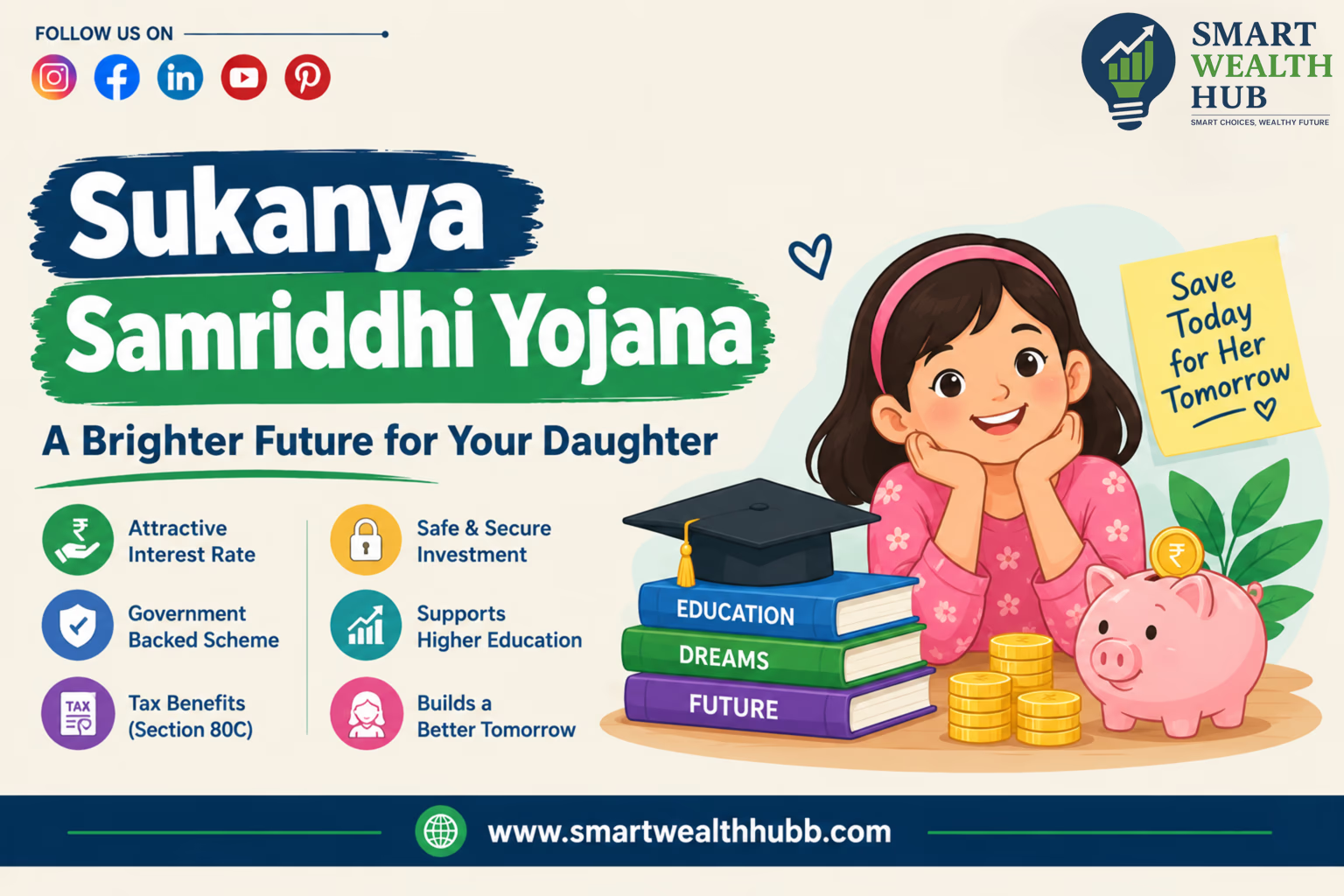
What Is Sukanya Samriddhi Yojana?
Sukanya Samriddhi Yojana (SSY), formally operated through the Sukanya Samriddhi Account, is a Government of India small-savings scheme designed to encourage long-term savings for the financial needs of a girl child.
The account can be opened by a natural or legal guardian for a girl child who has not attained the age of 10 years on the date of account opening. A maximum of two SSY accounts can generally be opened for two girl children in a family, subject to the applicable rules.
The scheme is particularly structured around long-term goals such as higher education and other significant future expenses. It combines a government-notified interest rate with tax benefits and a long investment horizon.
For parents comparing SSY with other long-term savings products, it is useful to understand the different post-office savings schemes before deciding how to allocate savings.
Sukanya Samriddhi Yojana Interest Rate
The SSY interest rate is notified by the Government of India and can be revised periodically.
The rate published by India Post is 8.2% per annum in its SSY information, with interest rates subject to quarterly revision. Therefore, the applicable rate should always be checked for the relevant quarter before making financial projections.
Unlike a market-linked investment, the SSY interest rate is not determined by daily market movements. However, the rate applicable in future years cannot be assumed to remain unchanged.
This distinction is important when using an investment calculator to estimate long-term wealth.
Who Is Eligible to Open an SSY Account?
The main eligibility conditions include:
- The account is opened in the name of a girl child.
- The girl must be below 10 years of age when the account is opened.
- A natural or legal guardian can open the account.
- Generally, one account can be opened for each eligible girl child.
- A family can generally have accounts for up to two girl children, subject to applicable provisions.
- The birth certificate of the girl child is an important document for establishing age and identity.
If the account is opened when the child is young, the long investment period can allow the accumulated balance to benefit significantly from compounding.
Minimum and Maximum SSY Deposit
The scheme allows deposits within specified limits.
A minimum annual contribution is required to keep the account regular, while the maximum deposit permitted in a financial year is ₹1.50 lakh. India Post also states that monthly deposits are not compulsory.
Therefore, a parent does not necessarily need to contribute every month.
For example, an investor could contribute:
₹12,500 × 12 = ₹1,50,000 per year
or make contributions at different intervals, provided the applicable annual limits and deposit rules are followed.
The ₹1.50 lakh annual ceiling is particularly relevant because it also corresponds to the overall Section 80C deduction limit, although Section 80C covers several eligible investments and payments—not just SSY.
How Long Do You Need to Deposit Money?
One important feature of SSY is that the deposit period and maturity period are different.
Deposits can generally be made for 15 years from the date of account opening, while the account matures 21 years from the date of opening.
For example:
- Account opened: 1 April 2026
- Deposit period: approximately 15 years
- Maturity: approximately 21 years from account opening
This means deposits stop before the final maturity date, but the accumulated balance can continue earning interest according to the applicable scheme rules.
This long period is one reason SSY should generally be considered for a specific long-term financial goal rather than short-term liquidity.
Sukanya Samriddhi Yojana Calculation Example
Consider a hypothetical investor who deposits the maximum ₹1,50,000 every year for 15 years.
For illustration, assume:
- Annual deposit = ₹1,50,000
- Deposit period = 15 years
- Assumed interest rate = 8.2% per year
- No withdrawals
- Interest rate remains unchanged throughout the illustration
Total amount deposited: ₹1,50,000 × 15 = ₹22,50,000
Using an annual-compounding approximation, the accumulated amount after the 15-year contribution period would be approximately ₹44.76 lakh.
If that amount then compounds for another six years at the same assumed 8.2% rate, the illustrative maturity value would be approximately: ₹44.76 lakh × (1.082)⁶ ≈ ₹71.82 lakh
Therefore:
| Particular | Illustrative amount |
|---|---|
| Annual contribution | ₹1,50,000 |
| Total contribution over 15 years | ₹22,50,000 |
| Illustrative balance after 15 years | ~₹44.76 lakh |
| Illustrative value after 21 years | ~₹71.82 lakh |
Important: This is an illustration, not a guaranteed maturity projection. Actual SSY interest rates can change because the Government periodically notifies small-savings rates. Actual interest calculation also depends on the timing of deposits and the applicable scheme rules.
For a more personalized estimate, readers can use an investment and savings calculator and test different annual contribution amounts and assumed rates.
SSY Tax Benefits
Sukanya Samriddhi has important tax advantages.
1. Deduction under Section 80C
Eligible deposits into SSY qualify for deduction under Section 80C, subject to the overall Section 80C limit.
The combined deduction limit under Sections 80C, 80CCC and 80CCD(1) is ₹1.50 lakh. This is an overall limit covering multiple eligible investments and payments.
For example, suppose a parent has:
- SSY contribution = ₹1,00,000
- Eligible EPF contribution = ₹50,000
The total potentially eligible amount is ₹1,50,000, subject to the applicable tax rules and the individual's circumstances.
If the person already has ₹1.50 lakh of other eligible Section 80C investments, an additional SSY contribution would not create an additional Section 80C deduction.
2. Tax Treatment of Interest
The interest earned on an eligible SSY account is exempt from income tax under the provisions applicable to the scheme.
3. Tax Treatment of Withdrawal
Eligible withdrawals under the SSY rules are also exempt from income tax.
The Income Tax Department's circular explaining the scheme specifically records the three-part tax treatment: eligible investment deduction under Section 80C, exemption of interest, and exemption of qualifying withdrawals.
Important Point About the New Tax Regime
Taxpayers should not automatically assume that every Section 80C investment produces a deduction regardless of the tax regime selected.
The Income Tax Department's current guidance identifies Section 80C deductions under the old tax regime.
Therefore, before investing specifically for the Section 80C benefit, check whether the tax regime you use permits the deduction and whether you have sufficient taxable income against which the deduction can be used.
The tax-exempt treatment of SSY interest and qualifying withdrawals is a separate consideration from the availability of the Section 80C deduction.
SSY Withdrawal Rules
SSY is designed primarily as a long-term savings product, so premature access to the money is restricted.
India Post states that withdrawal of up to 50% of the balance can be permitted for higher education after the girl child has attained 18 years of age or passed Class 10, whichever is earlier, subject to the applicable rules and documentation.
The withdrawal is therefore not equivalent to having unrestricted access to a bank savings account.
For an education-related withdrawal, the applicable documentation and conditions need to be satisfied.
Can an SSY Account Be Closed for Marriage?
The scheme provides provisions for closure when the account holder reaches the prescribed age and the account is being closed in connection with marriage, subject to the applicable rules.
Because premature closure provisions have specific conditions, account holders should confirm the current rules with the bank or post office maintaining the account before making a closure request.
What Happens If the Minimum Deposit Is Not Made?
SSY requires the prescribed minimum annual contribution to keep the account regular.
If the required minimum is not deposited, the account can become irregular. The applicable rules provide mechanisms for regularisation, including payment of the required amount and prescribed penalty, subject to the rules applicable at the time.
It is therefore sensible to maintain a yearly reminder rather than treating SSY contributions as optional.
Advantages of Sukanya Samriddhi Yojana
Some notable features include:
Government-backed structure
SSY is part of the government's small-savings framework, rather than a market-linked equity product.
Long investment horizon
The 21-year maturity structure can be useful for long-term goals.
Tax benefits
Eligible contributions can qualify under Section 80C, while interest and qualifying withdrawals receive tax-exempt treatment under the applicable provisions.
Compounding
Long-term compounding can significantly increase the difference between total contributions and the eventual account balance.
Structured savings
The restrictions on withdrawal can help preserve money for the intended long-term objective.
Limitations of Sukanya Samriddhi Yojana
SSY also has limitations that should be considered.
Limited liquidity: Money cannot generally be withdrawn freely whenever required.
Girl-child specific: The scheme is designed specifically for eligible girl children and is not a general-purpose investment account.
Interest-rate changes: The government can revise small-savings interest rates periodically, so today's rate should not automatically be assumed for the next 15–21 years.
Long lock-in: The long maturity period may not suit families that expect to need the money earlier.
Section 80C limitation: The tax deduction is subject to the overall ₹1.50 lakh Section 80C limit and the applicable tax regime.
SSY vs Other Investments
SSY should be evaluated according to the financial objective rather than simply by comparing headline interest rates.
For a child's future education, a parent may consider a combination of:
- Government-backed savings
- Fixed-income investments
- Mutual funds
- Insurance protection
- Bank deposits
- Other goal-oriented investments
The appropriate combination depends on the investment horizon, liquidity requirement, risk tolerance and financial objective.
Readers can also explore related financial planning and investment articles to compare different savings and investment approaches.
Who Should Consider Sukanya Samriddhi Yojana?
SSY may be relevant for parents or guardians who:
- Have an eligible girl child below 10 years of age.
- Want to build a long-term education or future-goal corpus.
- Prefer a government-backed small-savings structure.
- Can leave the money invested for a long period.
- Can make contributions within the scheme's limits.
- Understand that the applicable interest rate can change over time.
It may be less suitable for someone who needs frequent access to the invested money or whose financial objective is only a few years away.
Final Takeaway
Sukanya Samriddhi Yojana is a long-term government-backed savings scheme designed specifically for an eligible girl child. Its key characteristics include a long maturity period, contributions for up to 15 years, a maximum annual contribution of ₹1.50 lakh, government-notified interest rates, and tax benefits under the applicable provisions.
The biggest benefit of SSY is not simply its current interest rate. The combination of long-term compounding, disciplined contributions and tax treatment can make it relevant for long-term financial goals.
However, investors should not assume that the current 8.2% rate will remain unchanged for 21 years. Interest rates are periodically reviewed by the Government, and future returns will depend on the rates applicable during the investment period.
Before opening an account, compare SSY with other suitable investments based on the child's age, target amount, investment horizon, liquidity needs, taxation and overall financial plan.
Frequently Asked Questions
What is the current Sukanya Samriddhi Yojana interest rate?
The SSY interest rate published by India Post is 8.2% in its current scheme information. Small-savings interest rates are subject to periodic government revision, so the applicable quarterly rate should be checked before investing.
What is the maximum amount that can be deposited in SSY?
A maximum of ₹1.50 lakh can be deposited in an SSY account in a financial year.
Can SSY deposits qualify for a tax deduction?
Yes. Eligible SSY deposits qualify for deduction under Section 80C, subject to the overall ₹1.50 lakh Section 80C limit and the applicable tax regime.
When does the Sukanya Samriddhi account mature?
The account generally matures 21 years from the date of opening, while deposits are generally permitted for 15 years from account opening.
Can money be withdrawn from SSY before maturity?
Limited withdrawal is permitted under specified circumstances. For higher education, up to 50% of the eligible balance may be withdrawn after the girl reaches 18 years or passes Class 10, whichever is earlier, subject to the applicable rules and documentation.
These articles are for awareness. For advice suited to your goals, talk to our team.
Book a free consultationDisclaimer: Views in this article are for educational purposes and do not constitute personalised financial, tax, or investment advice. Markets involve risk — read all related documents carefully.





Comments0
No comments yet. Be the first to share a thought.