
Bonds vs PPF: Difference, Returns, Tax Benefits & Which Is Better?
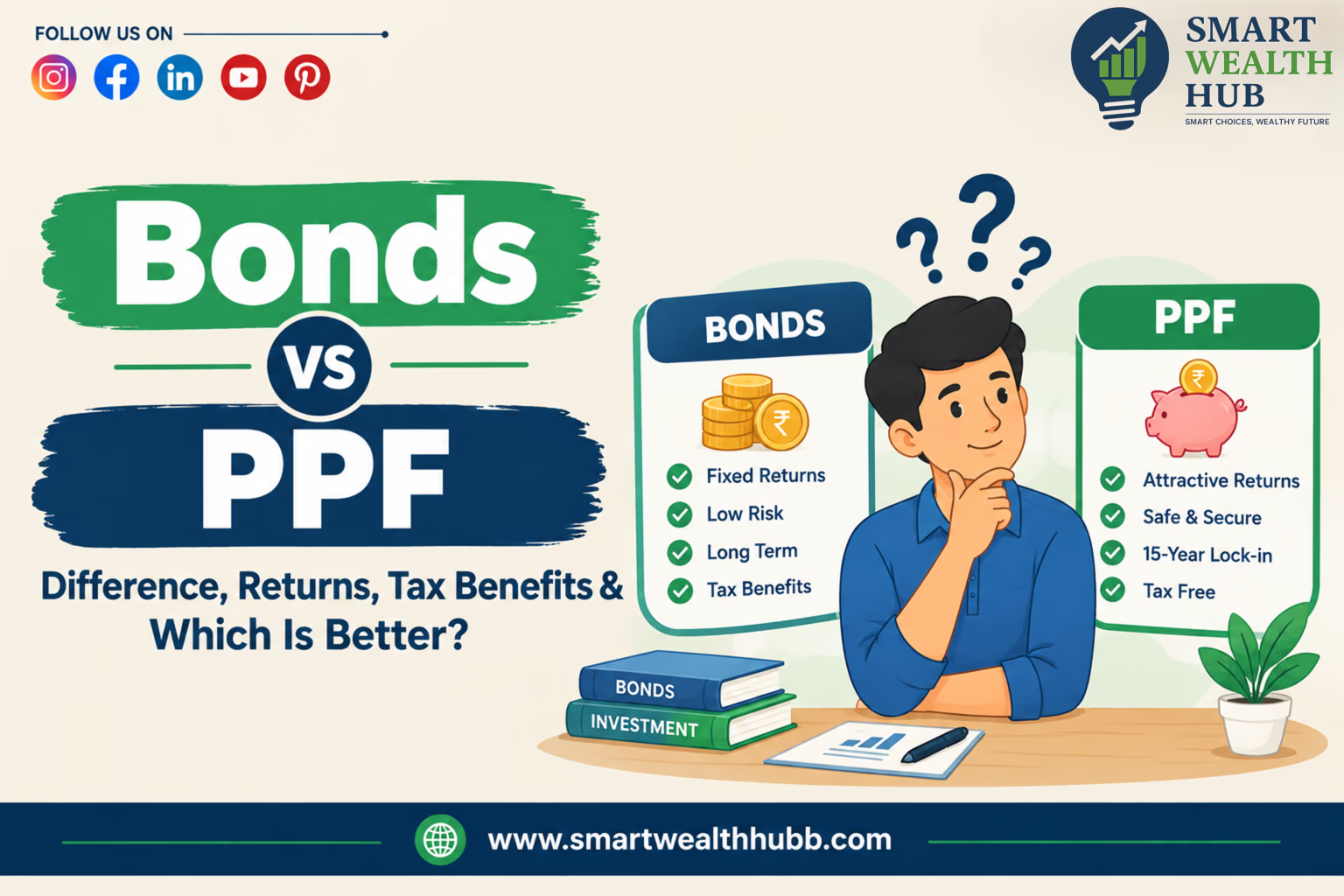
Bonds and PPF are not identical investments, so neither is universally better. PPF is designed for long-term disciplined savings with a government-backed structure and favourable tax treatment. Bonds provide a wider range of fixed-income securities, maturities and issuers, but their risk and taxation depend on the specific bond.
For investors with a long-term horizon who prioritise tax-efficient savings, PPF can be attractive. Investors looking for different maturity periods, potential secondary-market liquidity or a broader fixed-income allocation may consider bonds.
The right choice depends on your investment goal, risk tolerance, liquidity requirement, tax position and investment horizon.
What Are Bonds?
A bond is a debt instrument through which an investor lends money to an issuer. The issuer may be a government entity, company or another eligible organisation.
In return, the bond generally provides interest according to its terms and repayment of the principal at maturity.
For example, suppose you invest ₹1,00,000 in a bond with a 7% annual coupon.
Your annual coupon income would be: ₹1,00,000 × 7% = ₹7,000
If the bond pays this coupon annually for five years, the total contractual coupon received would be: ₹7,000 × 5 = ₹35,000
If the bond is held until maturity and the issuer fulfils its obligations, the original principal of ₹1,00,000 would ordinarily be repaid according to the bond terms.
However, 7% coupon does not automatically mean a 7% total return. The purchase price, sale price, accrued interest, taxes and reinvestment of coupon income can affect the investor's actual return.
Types of Bonds
Depending on the issuer and structure, investors may come across:
- Government securities
- Corporate bonds
- PSU bonds
- Tax-free bonds, where applicable
- Zero-coupon bonds
- Floating-rate bonds
- Other listed debt securities
Bonds can involve credit risk, interest-rate risk and liquidity risk, depending on the instrument.
SEBI's investor education material explains that bonds are debt instruments used by governments and corporations to raise funds.
What Is PPF?
PPF stands for Public Provident Fund.
It is a government-backed long-term savings scheme designed to encourage disciplined savings.
The PPF has an initial 15-year tenure and can be extended in blocks of five years subject to applicable rules. The interest rate is determined by the government and reviewed periodically.
The currently applicable PPF rate is 7.1% per annum, although investors should check the applicable rate for the relevant quarter because the rate is not permanently locked for the entire 15-year period.
Key PPF features include:
- Long-term savings structure
- Government-backed scheme
- 15-year initial tenure
- Five-year extension blocks
- Annual contribution limit of ₹1.50 lakh
- Interest rate reviewed periodically
- Tax benefits subject to applicable tax rules
Bonds vs PPF: Key Differences
| Feature | Bonds | PPF |
|---|---|---|
| Nature | Debt security | Government-backed savings scheme |
| Issuer | Government entities, companies and other eligible issuers | Government-backed scheme |
| Return | Coupon/yield depends on the bond | Government-notified interest rate |
| Current PPF rate | Not applicable | 7.1% p.a. currently |
| Risk | Depends on issuer and bond structure | Government-backed scheme |
| Tenure | Varies by bond | 15 years initially |
| Extension | Depends on bond terms | Five-year blocks |
| Liquidity | Some bonds can be sold before maturity | Limited withdrawals subject to rules |
| Annual investment limit | Depends on issue/instrument | ₹1.50 lakh |
| Taxation | Depends on bond and applicable tax rules | Favourable tax treatment subject to applicable law |
| Tax deduction | Depends on specific instrument | Eligible contributions can qualify under applicable tax provisions |
| Best suited for | Investors seeking fixed-income diversification | Long-term disciplined savings |
PPF vs Bonds: Which Is Safer?
The answer depends on the type of bond being compared with PPF.
PPF
PPF has a government-backed structure and does not have the same issuer-credit-risk characteristics as a corporate bond.
However, its interest rate can change when the government revises small-savings rates.
Bonds
Bonds are not one single risk category.
A sovereign government security and a lower-rated corporate bond should not be treated as having the same risk.
Corporate bonds may involve:
- Credit/default risk
- Interest-rate risk
- Liquidity risk
- Reinvestment risk
Therefore, investors should examine the issuer's credit quality, maturity, coupon, yield and liquidity before investing.
PPF vs Bonds: Which Gives Higher Returns?
There is no fixed answer.
Consider this simple example.
PPF at 7.1%
Suppose ₹1,00,000 is invested for one year at an illustrative rate of 7.1%.
₹1,00,000 × 7.1% = ₹7,100
Bond at 8%
Suppose ₹1,00,000 is invested in a taxable bond carrying an 8% coupon.
₹1,00,000 × 8% = ₹8,000
The bond produces ₹900 more in pre-tax coupon income.
But suppose the interest is taxable at an illustrative 20% marginal rate.
Tax: ₹8,000 × 20% = ₹1,600
Approximate post-tax interest: ₹8,000 − ₹1,600 = ₹6,400
Under this simplified illustration: PPF interest = ₹7,100
Bond post-tax interest = ₹6,400
This illustrates why investors should compare post-tax returns rather than headline interest rates.
Actual bond taxation can differ depending on the security and nature of income.
PPF Investment Calculation
Suppose you contribute ₹1,00,000 every year to PPF.
Your total contribution over 15 years would be: ₹1,00,000 × 15 = ₹15,00,000
If we assume, purely for illustration, that the interest rate remains at 7.1% throughout the entire period and contributions are made under a consistent annual-compounding assumption, the accumulated amount would be approximately ₹27.5 lakh.
That means the illustrative interest component would be approximately: ₹27.5 lakh − ₹15 lakh = ₹12.5 lakh
This is not a guaranteed maturity calculation because the PPF interest rate can be revised over time. Actual PPF interest also depends on the prescribed balance and deposit timing methodology.
PPF Calculator: Use a PPF maturity calculator to estimate the potential corpus based on annual contribution, investment period and assumed interest rate.
PPF Tax Benefits and the ₹1.5 Lakh Limit
Tax treatment is one of the most important differences between PPF and many taxable bonds.
The commonly cited ₹1.50 lakh Section 80C limit should be understood carefully.
An eligible PPF contribution can form part of the overall deduction limit applicable under the relevant tax provisions. It does not mean that every taxpayer automatically receives a ₹1.50 lakh tax saving.
For example, suppose an eligible taxpayer invests: ₹1,00,000 in PPF
If the entire ₹1,00,000 qualifies for the applicable deduction, the taxable income could potentially be reduced by ₹1,00,000, subject to the taxpayer's eligibility and applicable tax regime.
If the investor contributes: ₹1,50,000
the contribution could potentially use the full ₹1.50 lakh eligible limit, subject to the applicable rules.
Important 2026 Tax-Regime Consideration
Tax deductions need to be considered alongside the tax regime selected by the taxpayer.
The new tax regime is the default regime, while taxpayers meeting the relevant conditions can opt for the old regime where eligible deductions are available.
Therefore, simply investing ₹1.50 lakh in PPF does not mean every taxpayer will receive a ₹1.50 lakh deduction.
Is PPF Tax-Free?
PPF is widely considered a tax-efficient investment because its contributions, interest and qualifying maturity proceeds receive favourable tax treatment under the applicable provisions.
However, investors should distinguish between:
Tax deduction on contribution and Tax exemption on interest/maturity
These are separate concepts.
A tax deduction reduces taxable income, whereas tax exemption means qualifying income is not included in taxable income.
This distinction is particularly important when comparing PPF with taxable bonds.
Taxation of Bonds
Bond taxation depends on the specific security and the nature of the income.
Interest from taxable bonds can generally have tax implications. Sale or redemption of a bond can also have capital-gains consequences depending on the circumstances and applicable tax provisions.
Therefore, a bond offering an 8% coupon cannot automatically be compared with PPF's 7.1% rate simply by looking at the two percentages.
The more meaningful comparison is:
Pre-tax return → Tax impact → Post-tax return → Risk → Liquidity
This approach gives investors a more realistic basis for comparison.
Liquidity: Bonds vs PPF
Liquidity is another major difference.
Bonds
Some listed bonds can be sold before maturity in the secondary market.
However, liquidity is not guaranteed.
If market demand is low, an investor may have to sell at a price below the original purchase price.
Bond prices can also change when market interest rates change.
PPF
PPF is intended primarily for long-term savings.
It should therefore generally not be considered a substitute for an emergency fund.
Certain withdrawals and premature closure provisions exist under specified circumstances, but they are subject to the applicable PPF rules.
Bonds vs PPF for Retirement Planning
Both instruments can have a role in retirement planning, but they serve different purposes.
PPF may suit:
- Long-term retirement savings
- Investors seeking disciplined contributions
- Investors prioritising tax-efficient accumulation
- Investors comfortable with a long investment horizon
Bonds may suit:
- Investors seeking regular interest income
- Investors building a diversified debt allocation
- Investors requiring different maturity periods
- Investors who understand bond-market and issuer risks
A retirement portfolio does not necessarily need to rely exclusively on either option.
Bonds or PPF: Which Is Better?
Choose PPF if your priority is: Long-term + government-backed structure + tax efficiency + disciplined savings
Consider bonds if your priority is: Fixed-income diversification + maturity flexibility + potential liquidity + different yield opportunities
Neither option should be selected solely because it has the higher advertised rate.
Instead, compare:
- Return
- Post-tax return
- Credit risk
- Interest-rate risk
- Liquidity
- Tenure
- Investment limit
- Financial goal
Should You Invest in Both Bonds and PPF?
Yes, where appropriate.
PPF and bonds do not necessarily have to be competing investments.
For example, an investor could use PPF as a long-term savings component and bonds as part of a broader fixed-income allocation.
The appropriate allocation depends on the investor's:
- Age
- Income
- Existing investments
- Financial goals
- Risk tolerance
- Retirement requirements
- Liquidity needs
- Tax position
Bonds vs PPF: Final Verdict
The best investment between bonds and PPF depends on the investor, not simply the product.
PPF can be attractive for long-term investors who prioritise government-backed savings, disciplined contributions and favourable tax treatment.
Bonds can be useful for investors seeking a wider selection of fixed-income securities, maturity periods and yield opportunities. However, bond risk varies substantially according to the issuer and security.
For that reason, the right question is not: “Which gives the highest return?”
Instead, ask:
“Which investment provides the most appropriate risk-adjusted, post-tax outcome for my financial goal?”
That is the comparison that matters.
Frequently Asked Questions
Is PPF better than bonds?
PPF can be better for investors seeking long-term government-backed savings and favourable tax treatment. Bonds may be more suitable for investors seeking different maturities, yields and fixed-income securities.
What is the difference between bonds and PPF?
Bonds are debt securities issued by governments, companies and other eligible issuers, whereas PPF is a government-backed long-term savings scheme. Bonds vary in risk and maturity, while PPF follows prescribed scheme rules.
Which gives higher returns, bonds or PPF?
Neither always provides higher returns. A bond may have a higher headline coupon, but taxation, purchase price, credit risk and market value can affect the actual return. PPF's rate is government-determined and can be revised periodically.
Is PPF tax-free?
PPF receives favourable tax treatment under applicable tax laws. Eligible contributions may qualify for deductions under the applicable provisions, while interest and qualifying maturity proceeds receive favourable treatment.
Can I invest in both PPF and bonds?
Yes. PPF and bonds can potentially complement each other within a diversified financial plan, provided their risk, liquidity and tax characteristics are appropriate for the investor's objectives.
These articles are for awareness. For advice suited to your goals, talk to our team.
Book a free consultationDisclaimer: Views in this article are for educational purposes and do not constitute personalised financial, tax, or investment advice. Markets involve risk — read all related documents carefully.


Comments0
No comments yet. Be the first to share a thought.