
Senior Citizen Savings Scheme (SCSS): Interest Rate, Tax Benefits & Rules
What Is the Senior Citizen Savings Scheme (SCSS)?
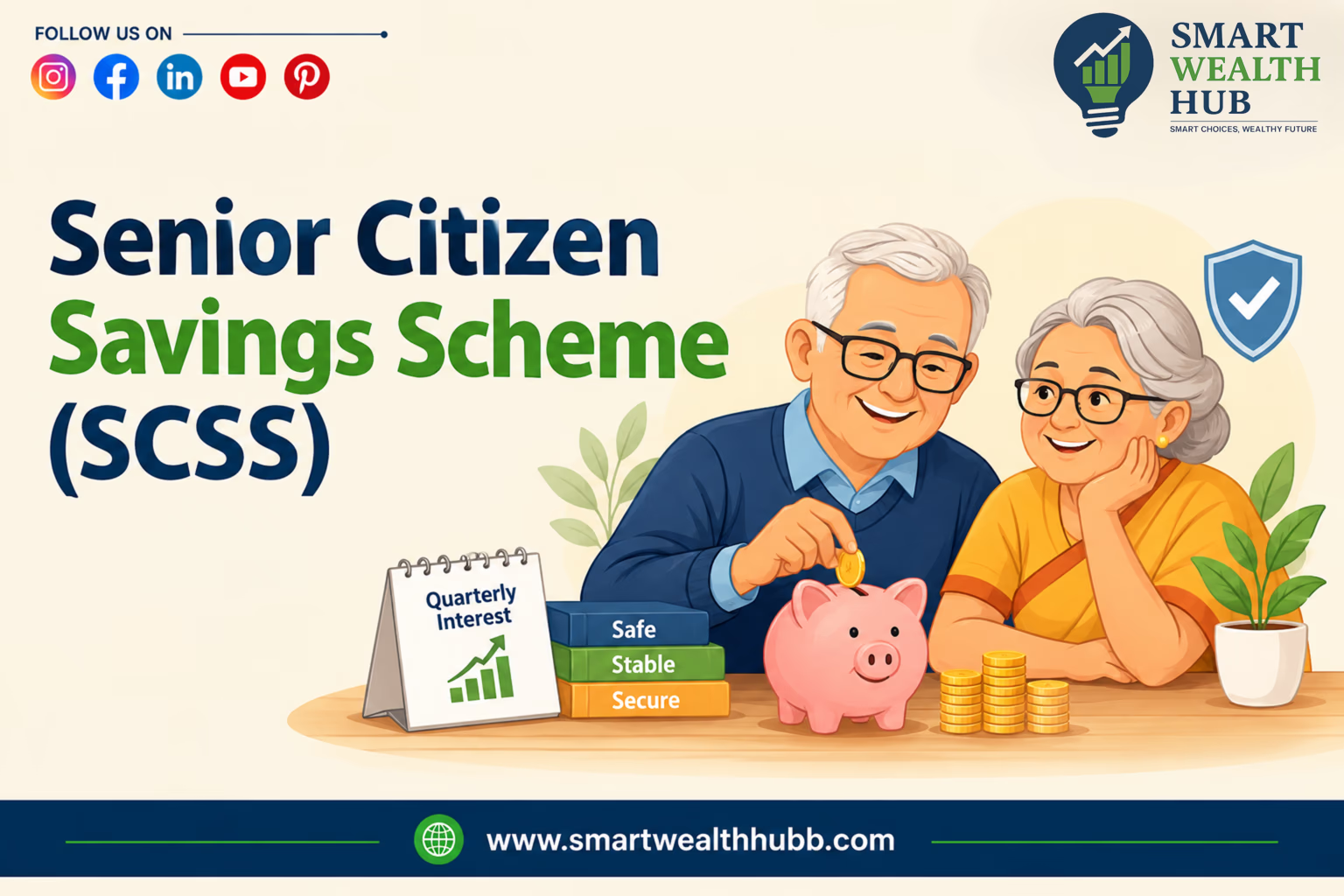
The Senior Citizen Savings Scheme (SCSS) is a government-backed small savings scheme designed primarily for eligible senior citizens seeking regular income from their savings.
The scheme combines a fixed tenure with quarterly interest payments. For the July–September 2026 quarter, the SCSS interest rate is 8.2% per annum. Small-savings interest rates are notified by the Government and can be reviewed periodically.
Unlike an accumulation-oriented investment where returns are reinvested automatically, SCSS is structured around periodic interest payouts. This can make it relevant for retirees who need a predictable cash flow from a portion of their savings.
Before investing, it is useful to compare SCSS with other retirement-income options and calculate how much quarterly income your investment could generate. You can also use an online investment calculator to estimate potential cash flows.
SCSS Interest Rate 2026
For the July–September 2026 quarter, SCSS offers an interest rate of 8.2% per annum. The rate is determined under the Government's small-savings framework and is subject to periodic notification.
The interest is paid quarterly, rather than being compounded and paid at maturity.
For example:
| SCSS Deposit | Annual Interest @ 8.2% | Approx. Quarterly Interest |
|---|---|---|
| ₹5 lakh | ₹41,000 | ₹10,250 |
| ₹10 lakh | ₹82,000 | ₹20,500 |
| ₹15 lakh | ₹1,23,000 | ₹30,750 |
| ₹20 lakh | ₹1,64,000 | ₹41,000 |
| ₹30 lakh | ₹2,46,000 | ₹61,500 |
The calculation is:
Annual Interest = Deposit × 8.2%
For a ₹30 lakh deposit: ₹30,00,000 × 8.2% = ₹2,46,000 per year
Quarterly interest: ₹2,46,000 ÷ 4 = ₹61,500
Therefore, an investment of ₹30 lakh at 8.2% would generate approximately ₹61,500 per quarter, before considering applicable taxes.
The maximum aggregate SCSS deposit is currently ₹30 lakh, while the minimum deposit is ₹1,000 in multiples thereof.
Who Is Eligible for SCSS?
The scheme is primarily available to individuals who have reached the prescribed senior-citizen age.
Generally, an individual aged 60 years or above can open an SCSS account.
Certain younger retirees can also qualify. The National Savings Institute specifies eligibility for individuals aged 55 years or more but below 60 years who have retired under superannuation, VRS or Special VRS, subject to the applicable conditions. Eligible retired defence personnel can qualify from age 50, subject to prescribed conditions.
An SCSS account can generally be opened individually or jointly with a spouse. The joint-account facility is subject to the scheme's applicable rules.
Because eligibility can depend on the manner and timing of retirement, individuals below 60 should verify the applicable conditions before making the deposit.
How Much Can You Invest in SCSS?
The current SCSS investment range is:
- Minimum deposit: ₹1,000
- Maximum aggregate deposit: ₹30 lakh
- Deposits are made in prescribed multiples of ₹1,000.
- The maximum limit applies to the aggregate deposits permitted under the scheme rules.
Example
Suppose a retiree has ₹25 lakh available for retirement income.
At an annual rate of 8.2%: ₹25,00,000 × 8.2% = ₹2,05,000 per year
Quarterly income: ₹2,05,000 ÷ 4 = ₹51,250
Thus, before tax, the investment could provide approximately ₹51,250 every quarter at the stated rate.
The actual rate applicable to a new account should always be checked at the time of investment.
SCSS Maturity Period
The standard SCSS maturity period is five years from the date of opening the account. Under the applicable rules, the account can be extended for a further three years, subject to the prescribed conditions and procedure.
This means an investor can potentially structure SCSS as part of a medium-term retirement-income plan rather than treating it as a short-term savings account.
However, liquidity should be considered before investing because premature closure is subject to scheme-specific conditions and deductions.
SCSS Premature Withdrawal Rules
SCSS is not designed as a completely liquid investment.
Premature closure is permitted subject to the applicable rules and conditions. Current scheme guidance provides for deductions depending on how early the account is closed.
For example, current rules provide for different consequences where an account is closed:
- Before completion of one year
- After one year but before two years
- After two years
The applicable deduction can affect the amount ultimately received by the investor.
Therefore, money that may be required for immediate medical expenses, emergencies or other short-term obligations should generally not be committed to SCSS without considering the premature-closure rules.
Is SCSS Tax-Free?
No. SCSS interest is taxable income.
This is an important distinction. The fact that SCSS is a government-backed small savings scheme does not mean that the interest received is automatically exempt from income tax.
For example, suppose an investor deposits ₹30 lakh at 8.2%.
Annual interest: ₹30,00,000 × 8.2% = ₹2,46,000
The ₹2.46 lakh interest is income that needs to be considered for tax purposes according to the applicable tax regime and the taxpayer's overall income.
SCSS Tax Deduction Under Section 80C
SCSS deposits can qualify for deduction under Section 80C, subject to the applicable conditions and the overall Section 80C limit.
The combined Section 80C deduction limit is ₹1.5 lakh under the old tax regime.
Example
Suppose an eligible taxpayer invests: ₹2,00,000 in SCSS
However, assume the taxpayer has already used: ₹1,00,000 of Section 80C limit through other eligible investments.
The remaining available 80C limit would be: ₹1,50,000 − ₹1,00,000 = ₹50,000
Therefore, only ₹50,000 of the SCSS investment could potentially be accommodated within the remaining Section 80C limit, assuming all other eligibility conditions are met.
It is also important to distinguish between the old and new tax regimes. The new tax regime is the default regime and generally does not allow deductions such as Section 80C; taxpayers eligible to opt out can choose the old regime subject to the applicable rules.
Therefore, investors should not assume that an SCSS deposit automatically creates a tax deduction under whichever tax regime they use.
SCSS TDS Rules
SCSS interest can attract Tax Deducted at Source (TDS) when the applicable threshold is crossed.
From 1 April 2025, the TDS threshold for interest paid to a senior citizen by a bank, qualifying co-operative society or post office was increased to ₹1 lakh.
This does not mean that interest below ₹1 lakh is tax-free. It means that TDS is generally not required when the relevant threshold is not crossed, subject to the applicable provisions.
Example
Suppose a senior citizen earns: ₹90,000 SCSS interest
If the applicable TDS threshold is ₹1 lakh, TDS may not be deducted merely because the interest is earned. However, the ₹90,000 can still form part of taxable income.
If the annual interest is: ₹1,20,000 the relevant TDS provisions may apply.
The distinction between TDS and final income-tax liability is important: TDS is a tax collection mechanism, whereas the final tax payable depends on total taxable income, deductions, rebates and the applicable tax regime.
Can Senior Citizens Claim 80TTB on SCSS Interest?
Section 80TTB provides a deduction of up to ₹50,000 for eligible resident senior citizens on specified interest income from deposits with banks, post offices and qualifying co-operative banks, subject to the applicable conditions.
However, taxpayers using the new tax regime should note that Chapter VI-A deductions such as 80TTB are generally not available under the default new regime.
This makes tax-regime selection an important part of evaluating the post-tax return from SCSS.
SCSS vs Bank Fixed Deposit
SCSS and bank fixed deposits can both be used for generating relatively predictable interest income, but they differ in structure.
| Feature | SCSS | Bank FD |
|---|---|---|
| Intended audience | Eligible senior citizens | General investors |
| Maximum SCSS deposit | ₹30 lakh | Depends on bank/product |
| SCSS rate for Jul–Sep 2026 | 8.2% | Varies by bank and tenure |
| Interest payment | Quarterly | Depends on selected option |
| Taxation | Interest taxable | Interest taxable |
| Section 80C | Eligible subject to conditions | Generally not for ordinary FDs |
| Liquidity | Subject to SCSS premature-closure rules | Depends on bank FD terms |
| Government small-savings framework | Yes | No |
The comparison should be made using post-tax income, liquidity, tenure and the investor's overall asset allocation, rather than only the headline interest rate.
Advantages of SCSS
Some of the important features of SCSS include:
1. Regular quarterly income
Interest is paid quarterly, making the scheme relevant for retirees who need periodic cash flow.
2. Government-backed small-savings framework
SCSS is part of the Government's small savings system and is administered through permitted channels including post offices and designated banks.
3. Defined maturity
The standard maturity period is five years, providing a clear time horizon.
4. Potential Section 80C benefit
Eligible investments can qualify under Section 80C within the overall applicable limit and tax-regime conditions.
5. Relatively simple structure
The scheme does not require investors to monitor market prices or equity-market volatility.
Limitations of SCSS
SCSS also has limitations that should be considered.
Interest is taxable: The quoted rate is not the same as the post-tax return.
Investment ceiling: The maximum aggregate SCSS deposit is ₹30 lakh.
Limited liquidity: Premature closure is governed by specific rules and may involve deductions.
Interest-rate risk for future investments: Government-notified small-savings rates can change over time. The rate applicable to a new account should be checked when investing.
Inflation risk: Even a nominally stable interest income may lose purchasing power if inflation remains high.
Concentration risk: Retirement savings should not necessarily be concentrated entirely in one instrument. Liquidity, healthcare expenses, inflation and long-term growth requirements should also be considered.
How to Use SCSS in a Retirement Plan
SCSS can be viewed as one component of a broader retirement-income strategy.
For example, a retiree could divide retirement assets across different purposes:
- Emergency reserve: Easily accessible savings
- Regular income: Instruments such as SCSS
- Healthcare reserve: Dedicated liquid funds
- Long-term growth: Appropriate market-linked investments based on risk tolerance
- Legacy planning: Assets structured according to family and estate-planning requirements
The objective is not simply to maximise the interest rate. The more relevant question is whether the combination of income, liquidity, tax efficiency and capital preservation matches the retiree's financial requirements.
You can also review related retirement and investment resources through the financial planning and investment articles.
SCSS Calculation: How Much Capital Is Needed?
Suppose a retiree wants approximately ₹30,000 per quarter from SCSS.
At an assumed rate of 8.2%:
Annual requirement: ₹30,000 × 4 = ₹1,20,000
Required principal: ₹1,20,000 ÷ 8.2% = approximately ₹14,63,415
So, approximately ₹14.63 lakh would be required to generate ₹1.2 lakh of annual interest at 8.2%, before tax.
This is a simple illustration. The actual interest rate applicable to the account and payment calculation should be verified under the rules prevailing when the account is opened.
For more detailed planning, investors can use an investment and retirement calculator to model different deposit amounts and income requirements.
Important Regulatory Points to Check Before Investing
Before opening an SCSS account, investors should verify:
- The latest interest rate notified by the Government.
- Eligibility based on age and retirement status.
- The current maximum deposit limit.
- Whether the investment qualifies for Section 80C under the taxpayer's chosen tax regime.
- Applicable TDS provisions.
- Premature-closure rules.
- Maturity and extension rules.
- Nomination and joint-account requirements.
- The tax treatment of quarterly interest.
- Whether the planned investment leaves enough money available for emergencies.
The National Savings Institute and India Post publish scheme-related information, while the Department of Economic Affairs notifies small-savings interest rates.
Final Takeaway
The Senior Citizen Savings Scheme (SCSS) is structured to provide eligible senior citizens with a combination of a defined tenure, quarterly interest income and a government-backed small-savings framework.
At the 8.2% rate applicable for July–September 2026, a ₹30 lakh deposit would generate approximately ₹2.46 lakh of annual interest, or around ₹61,500 per quarter, before tax.
However, the headline interest rate should not be considered in isolation. Investors should also examine taxation, Section 80C eligibility, TDS, liquidity, premature-closure conditions, inflation and the role SCSS plays within their overall retirement portfolio.
Because Government rules, interest rates and tax provisions can change, investors should verify the latest notification and applicable tax rules before making an investment decision.
Disclaimer: This article is for educational and informational purposes only and should not be treated as personalised investment or tax advice. Scheme rates, tax provisions and regulatory requirements may change. Verify the latest applicable rules before investing.
Frequently Asked Questions
What is the current SCSS interest rate in 2026?
The SCSS interest rate is 8.2% per annum for the July–September 2026 quarter. Small-savings rates are subject to Government notification and should be checked for the relevant quarter.
What is the maximum amount that can be invested in SCSS?
The current maximum aggregate SCSS deposit is ₹30 lakh, with a minimum deposit of ₹1,000 in multiples thereof.
Is SCSS interest taxable?
Yes. SCSS interest is taxable income according to the applicable income-tax provisions and the taxpayer's chosen tax regime.
Does SCSS qualify for Section 80C?
Eligible SCSS deposits can qualify for Section 80C deduction, subject to the overall ₹1.5 lakh Section 80C limit and applicable conditions. Section 80C deductions are generally unavailable under the new tax regime.
Can SCSS be closed before five years?
Yes, premature closure is permitted subject to the applicable SCSS rules and deductions. Investors should check the specific closure conditions before withdrawing early.
These articles are for awareness. For advice suited to your goals, talk to our team.
Book a free consultationDisclaimer: Views in this article are for educational purposes and do not constitute personalised financial, tax, or investment advice. Markets involve risk — read all related documents carefully.


Comments0
No comments yet. Be the first to share a thought.