
Commercial Vehicle Insurance: Coverage, Benefits, Premium & Policy Guide India
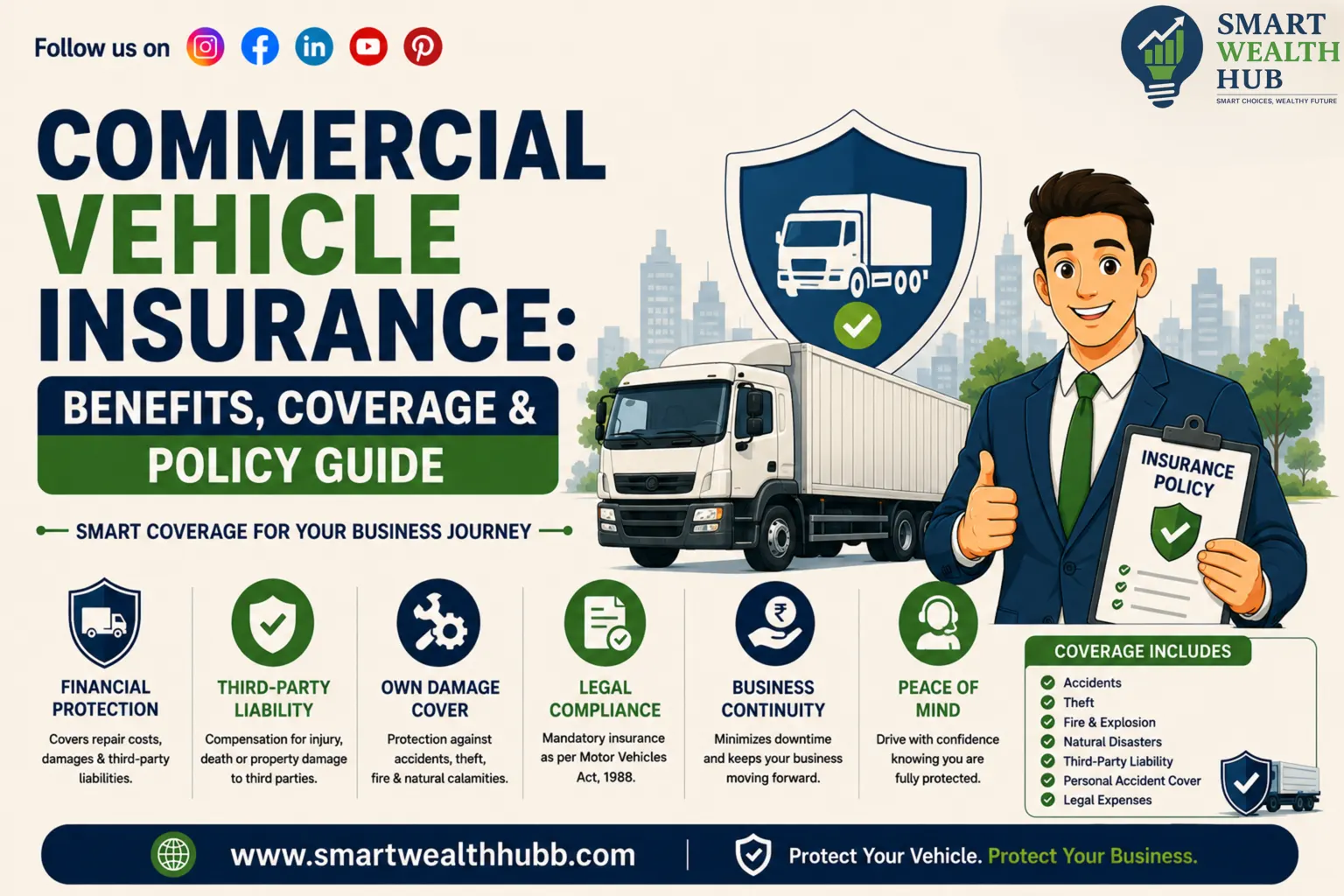
Commercial vehicles are essential assets for businesses involved in transportation, logistics, passenger services, delivery operations and goods movement. A single accident, theft or major vehicle damage can create significant financial pressure, especially when the vehicle is directly responsible for generating business income.
Commercial vehicle insurance is designed to protect businesses and vehicle owners against financial losses arising from accidents and other covered events. Depending on the policy selected, protection may include third-party liability, damage to the insured vehicle, theft and selected additional risks.
This guide explains how commercial vehicle insurance works in India, what it covers, how premiums are calculated, the applicable regulatory framework, tax treatment and how to select an appropriate policy.
Related guide: Browse more insurance and financial education resources.
What Is Commercial Vehicle Insurance?
Commercial vehicle insurance is a motor insurance policy designed for vehicles used for business or commercial purposes.
These vehicles may include:
- Trucks and goods carriers
- Taxis and cabs
- Buses and passenger vehicles
- School buses
- Auto-rickshaws used commercially
- Delivery vans
- Pickup vehicles
- Logistics vehicles
- Agricultural and specialised commercial vehicles
The insurance requirements and premium can vary depending on the vehicle category, usage, seating or carrying capacity, geographical location, declared vehicle value and claims history.
A commercial vehicle should generally be insured according to its actual permitted usage. Using an incorrectly classified policy may create complications during a claim.
Why Is Commercial Vehicle Insurance Important?
A commercial vehicle can create two major categories of financial risk.
1. Liability Risk
An accident may result in injury, death or property damage involving third parties. The resulting liability can be financially significant.
Third-party motor insurance is mandatory under India's motor vehicle law for vehicles used on public roads. Government and regulatory material also recognises third-party liability cover as a mandatory requirement under the Motor Vehicles Act framework.
2. Damage to Your Business Asset
A commercial vehicle may suffer damage due to:
- Road accidents
- Fire
- Theft
- Natural disasters
- Certain other insured events
Repairing or replacing a commercial vehicle without insurance can significantly affect business cash flow.
For example, assume a delivery vehicle requires repairs costing ₹4,00,000 after an accident. If the policy covers the loss subject to applicable deductibles, depreciation and policy conditions, insurance can substantially reduce the owner's direct financial burden.
Types of Commercial Vehicle Insurance
Third-Party Commercial Vehicle Insurance
Third-party insurance provides protection against legal liability arising from injury, death or property damage suffered by a third party because of the insured vehicle's use.
This is the minimum legally required form of motor insurance for vehicles operating on public roads.
However, third-party insurance generally does not cover damage to the insured commercial vehicle itself.
Comprehensive Commercial Vehicle Insurance
A comprehensive or package policy generally combines:
- Third-party liability protection
- Own-damage protection for the insured vehicle
Subject to policy terms and exclusions, own-damage coverage may protect against risks such as:
- Accidental damage
- Theft
- Fire
- Certain natural calamities
- Certain man-made events
The exact scope depends on the policy wording and selected coverage.
Standalone Own-Damage Cover
Where permitted and structured appropriately, an owner may maintain mandatory third-party insurance separately and obtain own-damage protection for the commercial vehicle.
Before selecting this arrangement, it is important to ensure that coverage periods and policy details remain valid and correctly coordinated.
What Does Commercial Vehicle Insurance Cover?
Coverage depends on the type of policy.
Third-Party Coverage
A third-party policy may address liabilities arising from:
- Death of a third party
- Bodily injury to a third party
- Damage to third-party property, subject to applicable legal and policy provisions
The Motor Vehicles Act framework makes third-party motor insurance a core legal requirement for vehicles used on public roads.
Own-Damage Coverage
A comprehensive policy may cover financial loss resulting from:
- Collision or accidental damage
- Fire and explosion
- Theft
- Flood
- Storm
- Earthquake
- Riot or similar insured events
Coverage should always be verified against the specific policy wording.
Add-On Covers for Commercial Vehicles
Add-ons can extend protection beyond the standard policy. Depending on availability and vehicle type, options may include:
Zero Depreciation
During repairs, depreciation may be applied to replaced parts. A zero-depreciation-style add-on can reduce the impact of depreciation deductions, subject to policy terms.
Roadside Assistance
This may provide assistance for events such as:
- Breakdown
- Flat tyres
- Battery issues
- Towing requirements
Engine Protection
Standard policies may have limitations regarding certain consequential engine damage. Engine protection may offer additional coverage under specified circumstances.
Return to Invoice
For eligible total-loss or theft situations, this type of cover may provide enhanced settlement protection based on policy terms.
Before purchasing an add-on, compare its additional premium with the financial benefit it may realistically provide.
How Is Commercial Vehicle Insurance Premium Calculated?
Commercial vehicle insurance premiums are not based on one fixed formula. Insurers generally consider multiple risk factors.
Important factors include:
- Vehicle type
- Vehicle age
- Insured Declared Value (IDV)
- Engine capacity or vehicle specifications
- Goods or passenger carrying capacity
- Vehicle usage
- Geographical area
- Claims history
- No Claim Bonus eligibility
- Add-on covers
- Driver and employee-related coverage requirements
Example Premium Calculation
Assume a goods-carrying vehicle has the following illustrative premium structure:
| Premium Component | Illustrative Amount |
|---|---|
| Base own-damage premium | ₹28,000 |
| Third-party premium | ₹22,000 |
| Add-on covers | ₹5,000 |
| Total before applicable taxes | ₹55,000 |
The final payable premium may increase after applicable taxes and statutory charges.
This is only an illustration. Actual premiums vary based on insurer underwriting, vehicle category and applicable regulations.
You can also direct readers to an internal premium estimation tool such as:
Estimate your insurance-related costs: Insurance and Financial Tools.
Understanding IDV in Commercial Vehicle Insurance
The Insured Declared Value (IDV) represents an agreed value used as a basis for settlement in certain total-loss or theft situations, subject to policy conditions.
For example:
Vehicle's applicable market value = ₹20,00,000
If the calculated IDV is approximately ₹16,00,000, the maximum settlement for a total-loss claim may generally be linked to the applicable IDV and policy conditions rather than the original purchase price.
Choosing an unrealistically low IDV may reduce premium but can also reduce potential claim protection.
Commercial Vehicle Insurance Claim Process
The exact claim procedure varies between insurers, but the general process typically includes the following steps.
Step 1: Inform the Insurer
Notify the insurer as soon as reasonably possible after an accident, theft or other covered incident.
Step 2: File Required Reports
For theft, serious accidents or other legally reportable incidents, an FIR or police documentation may be required.
Step 3: Submit Documents
Common documents may include:
- Insurance policy details
- Vehicle registration certificate
- Driving licence
- Permit documents where applicable
- FIR or police report where required
- Claim form
- Repair estimates
Step 4: Vehicle Inspection
An authorised surveyor may inspect the vehicle before repair approval, depending on the nature and value of the claim.
Step 5: Repair and Settlement
Depending on the policy and garage arrangement, settlement may occur through a cashless process or reimbursement.
Never begin major repairs before following the insurer's claim procedure unless immediate action is necessary to prevent further loss or ensure safety.
Common Exclusions to Check
Commercial vehicle insurance does not cover every loss.
Common exclusions or restrictions may involve:
- Normal wear and tear
- Mechanical or electrical breakdown not covered by the policy
- Driving without a valid licence
- Vehicle use outside permitted conditions
- Illegal or unauthorised usage
- Driving under the influence of prohibited substances
- Consequential losses
- War-related exclusions
Policy wording should be reviewed carefully because exclusions vary.
Tax Treatment of Commercial Vehicle Insurance Premiums
Commercial vehicle owners should distinguish between personal tax deductions and business expense treatment.
Commercial motor insurance premiums do not generally fall under the commonly known personal deduction categories such as Section 80C. The Income Tax Department's current guidance, for example, lists Section 80C items such as life insurance premiums, provident fund and other specified investments—not ordinary commercial motor insurance premiums.
However, where a vehicle is genuinely used for business or professional purposes, relevant expenses may generally be considered while computing business income, subject to applicable tax law, documentation and the facts of the case. Section 37 principles allow expenditure incurred wholly and exclusively for business or professional purposes, subject to statutory conditions and exclusions.
Example
Suppose a transport business earns:
- Annual business revenue: ₹30,00,000
- Other allowable business expenses: ₹12,00,000
- Commercial vehicle insurance premium: ₹80,000
If the premium is allowable based on the applicable tax rules and the taxpayer's facts:
Business profit before considering insurance = ₹18,00,000
Less: Eligible insurance expense = ₹80,000
Revised taxable business profit = ₹17,20,000, before considering other applicable adjustments and deductions.
The actual tax treatment can depend on the taxpayer's accounting method, business structure, vehicle usage and applicable provisions. Professional tax advice is advisable for specific cases.
Regulatory Considerations in India
Motor insurance operates within the regulatory framework involving the Motor Vehicles Act and the Insurance Regulatory and Development Authority of India (IRDAI).
Third-party insurance is a fundamental legal requirement for vehicles operating on public roads. Regulatory obligations also require general insurers to participate in the motor third-party insurance market under the applicable framework.
Commercial vehicle owners should ensure that:
- Insurance remains continuously valid.
- Vehicle permits are valid.
- Fitness requirements are met where applicable.
- Drivers hold valid licences.
- The vehicle is used according to authorised purposes.
- Policy information is accurate.
Failure to maintain proper documentation or comply with policy conditions can affect claim handling.
How to Choose the Right Commercial Vehicle Insurance Policy
Consider these factors before purchasing or renewing a policy:
Choose the Right Coverage
Evaluate whether third-party-only protection is sufficient or whether comprehensive protection is more suitable.
Check the IDV
Ensure that the declared value reasonably reflects the vehicle's insurable value.
Compare Add-On Costs
Select add-ons based on operational risk rather than purchasing every available option.
Review Claim Conditions
Check:
- Deductibles
- Depreciation rules
- Documentation requirements
- Cashless garage availability
- Exclusions
Consider Business Downtime
Insurance may cover physical loss, but downtime can still affect revenue. Businesses should therefore maintain contingency plans for vehicle replacement or alternative transportation.
Final Thoughts
Commercial vehicle insurance is more than a legal requirement. For businesses that depend on transportation, it is an important risk-management tool.
A suitable policy can protect against third-party liabilities and, where comprehensive coverage is selected, help reduce the financial impact of damage, theft and other covered events.
The best approach is to match coverage with the vehicle's actual commercial use, financial value and operational risk. Before buying or renewing a policy, compare policy wording, exclusions, deductibles and add-ons—not only the premium.
Explore more guides: Insurance and Financial Education Blogs.
Frequently Asked Questions
Is commercial vehicle insurance mandatory in India?
Yes. Third-party motor insurance is mandatory for vehicles used on public roads under India's motor vehicle insurance framework.
What is covered under commercial vehicle comprehensive insurance?
Depending on the policy terms, comprehensive insurance can provide third-party liability protection along with own-damage coverage for risks such as accidents, theft, fire and certain natural calamities.
How is commercial vehicle insurance premium calculated?
The premium depends on factors including vehicle type, IDV, usage, carrying capacity, location, claims history, add-ons and applicable regulatory premium components.
Can commercial vehicle insurance premiums be treated as a business expense?
Where the vehicle and expense are genuinely connected with business or professional activities, the premium may be considered while computing taxable business income, subject to applicable tax provisions and individual facts. It should not automatically be treated as a personal tax deduction.
What documents are required for a commercial vehicle insurance claim?
Documents may include the policy details, registration certificate, valid driving licence, permit-related documents where applicable, claim form, repair estimate and police documentation such as an FIR when required.
These articles are for awareness. For advice suited to your goals, talk to our team.
Book a free consultationDisclaimer: Views in this article are for educational purposes and do not constitute personalised financial, tax, or investment advice. Markets involve risk — read all related documents carefully.




Comments0
No comments yet. Be the first to share a thought.